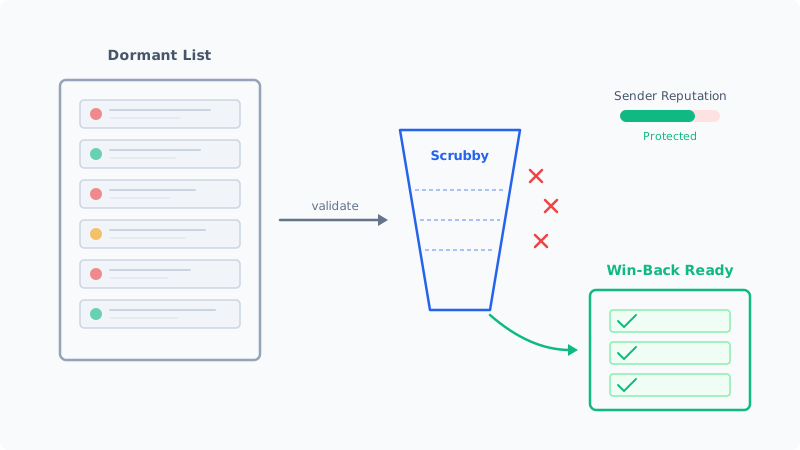
Win-back campaigns are one of the most valuable plays in email marketing. You already paid to acquire these subscribers. They already showed interest in your product. Getting even 5 to 10% of them back costs a fraction of acquiring new leads.
But win-back campaigns carry a hidden risk that most marketers underestimate: the subscribers you are trying to re-engage are the ones most likely to have abandoned their email addresses entirely.
A win-back list is, by definition, a list of people who stopped engaging. Some unsubscribed in spirit but not in action. They changed jobs, switched email providers, or simply abandoned the inbox. The address that was valid when they signed up 18 months ago may not exist anymore. And when you send a carefully crafted “we miss you” email to a dead mailbox, the only thing you win back is a hard bounce.
Why Win-Back Lists Are the Most Dangerous Lists You Own
Every email list decays over time. Industry data suggests that 22 to 30% of email addresses become invalid each year due to job changes, provider switches, and abandoned accounts. Your active subscribers mask this decay because regular engagement signals keep ISPs happy and bouncing addresses get removed through normal send cycles.
Win-back segments are different. These addresses have not received mail from you in months or sometimes years. During that silence, the natural decay rate has been compounding without any cleanup mechanism in place.
Consider the math. If your overall list decays at 25% per year and your win-back segment targets subscribers who have been inactive for 12 to 18 months, roughly one in four of those addresses no longer exists. Send to 10,000 dormant subscribers and you could generate 2,500 hard bounces in a single campaign.
That volume of bounces in one send is a deliverability catastrophe. Gmail, Microsoft, and Yahoo track bounce rates per sending domain. A single campaign with a bounce rate above 5% can trigger reputation downgrades that affect every email you send for weeks afterward.
The Catch-All Trap in Win-Back Lists
The problem gets worse with B2B win-back campaigns. Many business email addresses sit on catch-all domains where the mail server accepts all incoming mail regardless of whether the specific mailbox exists. Standard email validators see the server accepting connections and mark these addresses as valid.
But the person behind that address left the company eight months ago. The mailbox was deleted. The catch-all server still accepts the email, drops it into a void, and your analytics show a delivered email that nobody will ever read.
These phantom deliveries are arguably worse than hard bounces for win-back campaigns. Bounces at least tell you the address is dead so you can remove it. Catch-all deliveries to non-existent people silently destroy your engagement metrics. ISPs see emails consistently delivered but never opened, and that pattern of zero engagement from a segment of your sends damages your sender reputation just as effectively as bounces.
This is where tools like Scrubby provide critical value. While standard validators stop at server-level checks, Scrubby verifies whether the actual mailbox is deliverable on catch-all domains. For win-back campaigns targeting B2B subscribers, this distinction is the difference between re-engaging real people and sending into a void.
The Right Way to Prepare a Win-Back List
Step 1: Segment by Inactivity Duration
Not all dormant subscribers carry the same risk. Break your win-back list into tiers:
- 3 to 6 months inactive: lowest risk. Most addresses are still valid. Validate for hygiene but expect a low invalid rate.
- 6 to 12 months inactive: moderate risk. Job changes and provider switches start accumulating. Validation is essential.
- 12 to 24 months inactive: high risk. Expect 20 to 35% invalid rates. Aggressive validation and conservative sending are required.
- 24+ months inactive: extreme risk. Consider whether re-engagement is worth attempting. Invalid rates can exceed 40%.
This segmentation also informs your sending strategy. You do not want to send all tiers simultaneously. Start with the lowest-risk segment, confirm clean delivery metrics, then proceed to higher-risk tiers.
Step 2: Run Full Validation Before Any Send
Validate every address in the win-back list through a multi-layer verification process:
- Syntax and formatting check: catches obvious data entry errors, extra spaces, and malformed domains.
- Domain validation: confirms the domain exists and has active MX records. Domains expire, companies rebrand, and mail servers get decommissioned.
- Mailbox verification: confirms the specific address is deliverable. This is where standard validators fail on catch-all domains.
- Catch-all deep verification: for addresses on catch-all servers, determines whether the specific mailbox actually exists versus the server blindly accepting everything.
Steps 1 and 2 are table stakes. Steps 3 and 4 are where the real protection happens, and where most teams skip the work that matters most.
Step 3: Remove and Suppress
After validation, apply strict suppression rules:
- Invalid addresses: remove permanently from your database. These addresses are dead and should never receive another email.
- Risky or unverifiable addresses: move to a quarantine segment. Do not include them in the win-back campaign. Re-validate in 30 days and remove if still unverifiable.
- Role-based addresses (info@, support@, sales@): exclude from win-back campaigns. These were likely never personal subscribers and sending win-back content to them is pointless.
- Disposable email domains: remove. If someone signed up with a disposable address, they were never a real subscriber.
Step 4: Throttle Your Send
Even with a validated list, send your win-back campaign in controlled batches rather than all at once. This lets you monitor bounce rates and engagement in real time and stop the send if something unexpected happens.
A practical throttle schedule:
- Day 1: send to 10% of the validated list
- Day 2: review metrics. If bounce rate is under 2% and complaint rate is under 0.1%, proceed.
- Day 3: send to the next 30%
- Day 4-5: send to the remaining 60%
This approach limits blast radius. If validation missed something or a domain went down between validation and send, you catch it early before your entire reputation takes the hit.
Measuring Win-Back Campaign Health
Track these metrics to confirm your validation was effective:
Hard bounce rate: should be under 1% for validated segments. If you see 2% or higher, stop and re-validate the remaining unsent portion.
Soft bounce rate: elevated soft bounces (3 to 5%) are normal for win-back campaigns because some full mailboxes and rate-limited servers will temporarily reject. Monitor but do not panic unless soft bounces persist across retry attempts.
Spam complaint rate: win-back emails to people who forgot they subscribed generate complaints. Keep this under 0.1% by including clear unsubscribe links and honest subject lines. “We miss you” is fine. Misleading subject lines that trick opens will spike complaints.
Open rate by inactivity tier: compare engagement across your duration segments. If the 12-to-24-month tier shows near-zero opens despite clean delivery, those subscribers are functionally gone. Update your win-back policy to stop targeting that tier.
When Not to Run a Win-Back Campaign
Validation is not a magic wand. Some win-back scenarios are not worth the risk regardless of how clean your list is:
Your sender reputation is already damaged. If you are currently in the process of repairing deliverability, a win-back campaign adds unpredictable volume to a fragile reputation. Fix your reputation first, then re-engage dormant subscribers from a position of strength. If you are using outbound tools like Kali for calendar-based outreach alongside your email campaigns, the same principle applies: clean your lists before touching any sending channel.
The subscribers were low-quality at acquisition. If these subscribers came from a giveaway, purchased list, or co-registration where they did not explicitly opt in to your brand, winning them back is not really winning them back. They were never engaged in the first place.
You have no value proposition change. Win-back campaigns work when you have something new to offer: a product update, a pricing change, new content, or a genuine reason for the subscriber to care again. Sending “we noticed you have not opened our emails” to someone who intentionally stopped reading is not a re-engagement strategy. It is a reminder of why they left.
Conclusion
Win-back campaigns target the riskiest segment of your email database by design. The subscribers you are re-engaging are the ones most likely to have invalid addresses, full mailboxes, and zero intent to engage.
Validate before you send. Segment by risk. Throttle your volume. Monitor in real time. The win-back revenue is real, but only if your deliverability survives the campaign.

Scrubby Team
Admin