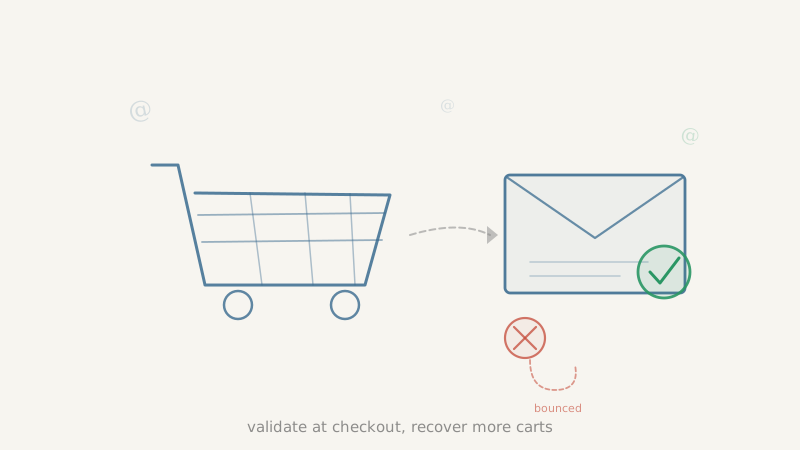
Abandoned cart recovery is one of the highest-ROI workflows in ecommerce. The average cart abandonment rate across industries sits between 70 and 80 percent. A well-timed recovery sequence can bring back 5 to 15 percent of those shoppers, often without discounting. That is real revenue from people who already decided to buy.
But none of it works when the email bounces.
Ecommerce teams invest significant effort into abandoned cart copy, timing, subject lines, and segmentation. Very few spend comparable effort on whether the email addresses in their cart recovery list are actually deliverable. That oversight is expensive, in two ways: direct revenue loss from sequences that never reach their intended recipient, and indirect damage to sender reputation that degrades deliverability across every campaign.
Why Abandoned Cart Emails Bounce More Than You Expect
Checkout forms are a high-friction environment. Shoppers who reach the cart stage but do not complete purchase often fall into one of several categories: genuinely undecided, distracted, price-comparing, or intentionally abandoning. Each category produces different email quality problems.
Intentional abandonment with a throwaway email. Some shoppers know they will be retargeted and use a disposable email address to get through the checkout flow, or to access a discount popup, without committing to future contact. These addresses may look syntactically valid but point to services specifically designed to accept and discard messages.
Typographical errors on mobile checkout. Mobile keyboards and small screens create consistent patterns of email typos. Transposed characters, missing dots, wrong domain extensions, and autocorrect substitutions all produce addresses that clear basic format validation but fail at delivery.
Old email addresses. Customers who shopped with you two or three years ago may have changed jobs, switched email providers, or abandoned old accounts. When they return to your store, their browser may autofill the old address they used previously. The address looks familiar and correct to them, but the mailbox is long gone.
Shared or catch-all corporate accounts. Business buyers shopping on behalf of their company sometimes use corporate email addresses on catch-all domains. These domains accept every incoming message at the server level regardless of whether the specific mailbox exists. Standard validation tools interpret that server acceptance as confirmation of deliverability, which it is not.
Fake addresses entered for early access or discount codes. If your store offers a discount popup in exchange for an email, or an early access list with a cart-stage prompt, some percentage of users enter fabricated addresses to claim the offer. When your cart recovery sequence fires, it fires into a void.
The Cost of Bounces on Sender Reputation
A bounce is not just a failed delivery. It is a signal that affects every email you send afterward.
Email platforms, whether Klaviyo, Mailchimp, Drip, Omnisend, or any other, monitor bounce rates continuously. Most enforce hard limits: a campaign that exceeds a 2 percent hard bounce rate triggers warnings, and repeated violations lead to account suspension. The threshold sounds generous until you realize that a modest list of 10,000 contacts with 5 percent invalid addresses will exceed it on the first send.
More importantly, inbox providers (Gmail, Outlook, Yahoo) evaluate your sending domain’s reputation based on cumulative signal history. Bouncing frequently tells those providers that your list hygiene is poor, which correlates statistically with spam-like behavior. The result is increased spam folder placement, even for emails going to your most engaged subscribers.
The damage compounds. Your welcome series, promotional campaigns, loyalty emails, and post-purchase flows all use the same sending domain. Reputation damage from one dirty cart recovery list affects all of them.
Getting that reputation back is not a quick fix. It requires months of sending exclusively to clean, engaged lists, often at reduced volume. The cost in missed revenue during recovery is rarely calculated alongside the initial campaign metrics, but it is real and it is significant.
What Standard Checkout Validation Misses
Most ecommerce platforms perform some level of email validation at checkout. Shopify, WooCommerce, BigCommerce, and their competitors check that the email field contains a properly formatted address before allowing the checkout to proceed.
That format check catches obvious errors: missing the @ symbol, no domain extension, spaces in the address. It does not check whether the mailbox actually exists. A perfectly formatted address pointing to a deleted account clears every standard checkout validation without question.
Some stores add a basic MX record check, verifying that the domain has mail server configuration. This improves accuracy slightly but still misses a large category of problems. A domain with valid MX records can still have thousands of non-existent mailboxes on it, particularly catch-all configured domains that accept everything at the server level.
The gap between format validation and deliverability validation is where most abandoned cart bounces come from.
Catch-All Domains in Ecommerce: A Special Problem
Catch-all domains deserve their own section because they are particularly common in ecommerce and particularly difficult to handle.
A catch-all domain is configured to accept any email sent to any address at that domain. If you send to anythingmadeup@catchalldomain.com, the server accepts the connection and the message appears to deliver. Standard validation tools see that server acceptance and mark the address as valid. But what happens after acceptance varies: the message might route to a shared inbox, get discarded silently, generate a delayed bounce, or go into a folder nobody monitors.
In ecommerce contexts, catch-all domains appear in several scenarios. Corporate purchasing departments often use catch-all configured domains so that no vendor email gets lost regardless of which employee address is used. Small business owners sometimes set up catch-all on their business domains for similar reasons. Some domains use catch-all as a backup after restructuring email addresses.
The standard behavior of a catch-all domain looks identical to a valid individual mailbox to most validation tools. Both accept the incoming connection. The difference only becomes visible at delivery time, when the message either silently disappears or generates a bounce that your platform registers days later.
Scrubby is built specifically to handle this problem. Rather than stopping at server-level acceptance, Scrubby performs additional verification to determine whether the specific mailbox is likely to deliver successfully, even on catch-all domains. For ecommerce teams, this means catch-all addresses can be classified accurately instead of being labeled valid by default and bouncing later.
How to Integrate Email Validation at Checkout
Integrating validation into your checkout flow does not require replacing your existing email collection. It means adding a verification layer between collection and your cart recovery sequence.
Real-Time API Validation at Checkout
The most effective approach is validating email addresses at the moment of entry using a verification API. When a shopper types their email and moves to the next field, the API checks the address and returns a result in under a second. If the address fails verification, you can prompt the shopper to correct it before they proceed.
For Shopify stores, this typically means adding a small JavaScript snippet to the checkout page that fires the API call on email field blur. For WooCommerce, a similar approach works via a lightweight plugin or custom function in functions.php. Headless commerce setups can integrate the API call at the frontend component level.
Real-time validation has the advantage of catching errors before they enter your system. The shopper is still present and can correct a typo on the spot, which actually improves their experience. It also keeps your CRM and email platform entirely clean from the start.
Batch Validation Before Sending
If real-time API integration is not immediately feasible, batch validation before your cart recovery sequence fires is the practical alternative.
Export your cart abandonment records for a given time window. Upload the list to Scrubby for batch validation. Scrubby processes each address, flags invalid and undeliverable contacts, identifies catch-all domains with mailbox-level verification, and returns results with clear status codes.
Send your recovery sequence only to addresses that pass validation. For addresses flagged as catch-all but not confirmed deliverable, consider a separate segment with reduced sending frequency and closer bounce monitoring.
This process takes about 10 to 15 minutes for most cart abandonment lists and can be built into your weekly or daily pre-send workflow.
Automation Pipeline Integration
For stores with established automation workflows, validation can slot directly into the cart recovery automation. When a cart abandonment event triggers, instead of immediately enrolling the contact in the recovery sequence, a validation step fires first.
Using tools like Vendisys for workflow orchestration or a Zapier/Make integration with the Scrubby API, the automation sends the email address for verification, receives the result, and either enrolls the contact in the full recovery sequence or routes them to a suppression list. This approach runs continuously with no manual intervention and keeps your active sequences permanently clean.
Practical Implementation Steps
Here is the sequence that works for most ecommerce operations, from immediate impact to longer-term infrastructure.
Step 1: Validate your existing cart abandonment list. Before your next recovery sequence send, run your full active list through batch validation. Remove hard bounces and unverified addresses. This prevents immediate reputation damage and gives you a baseline for your current list quality.
Step 2: Suppress unvalidated contacts rather than deleting them. Suppressed contacts can be re-validated periodically. Some addresses become deliverable again (for example, if a domain changes its catch-all configuration). Permanent deletion removes that option.
Step 3: Add validation to your checkout flow. Prioritize real-time API validation for new cart abandonment records. The earlier you catch invalid addresses, the cleaner your lists stay without manual intervention.
Step 4: Segment by validation status. Separate fully verified contacts from catch-all verified contacts in your recovery sequences. Monitor bounce and open rates by segment. Catch-all verified addresses may perform well or poorly depending on how those domains actually behave at delivery, and segment-level data tells you which.
Step 5: Set a validation cadence for older records. Cart abandonment contacts who entered your list more than 90 days ago should be re-validated before any sequence fires. Email addresses go stale fast, and a contact who was reachable last quarter may not be reachable now.
What Validation Does for Revenue Recovery
The impact shows up in two places: direct recovery rate and platform health.
On direct recovery, the math is straightforward. If your cart recovery sequence sends 1,000 emails with a 15 percent conversion rate and 20 percent of those emails bounce, you are effectively sending to 800 deliverable contacts. Removing the 200 bouncing addresses before they damage your reputation means you recover closer to the expected 150 conversions, not the 120 you get when reputation degradation starts suppressing delivery to your valid contacts too.
On platform health, the effect is broader. Clean sending signals improve your domain reputation over time, which means better inbox placement for all your campaigns, including promotional sends, loyalty programs, and transactional emails. Better inbox placement means higher open rates. Higher open rates mean more revenue from every campaign you send.
Validation is not a one-time fix. It is maintenance that protects the entire email channel, which for most ecommerce stores is one of the top two or three revenue drivers.
The Ecommerce Email Stack Deserves Better Data
Cart recovery is often treated as a set-and-forget automation. The sequence is built, the timing is configured, and the revenue attributed to it is logged as baseline performance. What rarely gets examined is how much of that performance is being suppressed by deliverability problems that originated at data collection.
Bad email data compounds quietly. A small percentage of invalid addresses introduced at checkout creates bounce events that gradually degrade domain reputation, which gradually reduces inbox placement, which gradually suppresses open rates on every campaign. The decline is slow enough that it rarely triggers alarm, but the cumulative revenue impact over a year of degraded sending is significant.
Validating email addresses before abandoned cart sequences fire is one of the simplest interventions available. It requires no changes to your sequence logic, no new creative, and no additional testing cycles. It requires only that you verify your audience before you broadcast to them.
Scrubby handles the verification layer so that your recovery sequences reach the inboxes they were written for. The revenue your cart recovery is supposed to generate should not be lost to bounces that a validation step could have prevented.

Scrubby Team
Admin