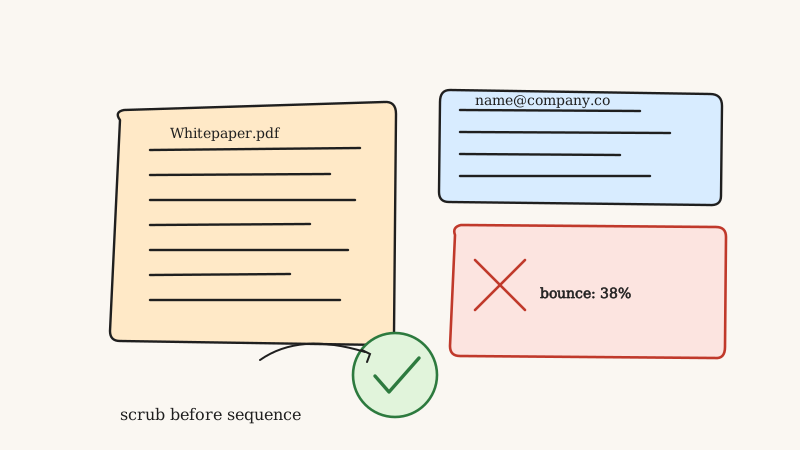
Gated content is one of the highest-volume lead capture mechanics in B2B marketing. Whitepapers, ebooks, research reports, benchmark data, and template libraries pull in thousands of email addresses every quarter. The catch: the people downloading those assets often want the asset, not a relationship with your brand. They will type anything that looks email-shaped, hit submit, and disappear with the PDF.
If you push that raw list straight into a nurture sequence, you will discover the cost the hard way. Bounce rates climb, spam complaints follow, and the sender reputation you spent months building burns down in a few days.
What “gated content emails” actually look like
A typical gated form list contains four distinct populations:
- Real prospects with work emails. These are the leads you actually want.
- Real prospects with personal emails. Gmail, Yahoo, Outlook addresses entered to dodge sales follow-up. Deliverable, but lower intent.
- Throwaway and disposable emails. Mailinator, 10MinuteMail, and a long tail of disposable domain providers. Deliverable for ten minutes, then dead.
- Typos, fakes, and outright garbage. “asdf@asdf.com”, role accounts that reject mail, addresses on domains that no longer exist.
Without validation you are pumping all four buckets into the same sequence. The last two buckets are doing measurable damage on every send.
Why this list is more dangerous than it looks
A list collected from a gated download has three properties that make it especially toxic to deliverability if you do not clean it.
Volume spikes are concentrated in time. A successful asset launch can pull in five thousand signups in a week. If even six percent are bad, that is three hundred bounces concentrated into a small window — exactly the pattern mailbox providers flag as spammer behavior.
The audience is cold. Unlike a customer list, these subscribers have no purchase history, no opens, no prior engagement. Mailbox providers have no positive signal to weigh against the bounces and complaints, so the negative signals dominate.
The intent skew is bad. People entering disposable emails are explicitly opting out of contact. When you email them anyway, complaint rates run two to three times higher than a properly opted-in list.
This combination is why teams that nurture raw gated lists often see their sender reputation collapse within one or two campaigns.
Validate before the first nurture send
The fix is not complicated, but the order matters. Validate the list before the first email goes out, not after you see the bounce report.
A purpose-built validator like Scrubby will flag four categories on a gated download list: invalid addresses (typos, dead domains), risky catch-all domains, disposable and temporary email providers, and role accounts (info@, sales@) that you may want to suppress. For most teams, removing just the first and third buckets is enough to bring bounce rates under one percent on the first send.
Run validation as a step in the data pipeline between form submission and CRM import. The asset still gets delivered to the user immediately, but the email only enters your nurture audience after it has been verified.
What “good” looks like after validation
Teams that properly validate gated content lists typically see:
- Bounce rate on first nurture send falls from 6 to 12 percent down to under 1 percent.
- Open rates climb 20 to 40 percent, because the denominator shrinks to real inboxes.
- Spam complaint rate drops below the 0.1 percent threshold mailbox providers use to throttle senders.
- The downstream MQL-to-SQL conversion rate improves, because the disposable and fake addresses were never going to convert anyway.
The list gets smaller. The performance gets dramatically better.
Where this fits with the rest of the outbound stack
Validation is the input quality layer. It works best when paired with the rest of your outbound infrastructure.
If you are following up gated downloads with a multichannel sequence, Kali handles the calendar invite step that converts engaged readers into booked demos. If you are running competitive content (a benchmark report against an alternative tool, for example), CAM helps you keep that positioning current as competitors shift their messaging. The point: validation is what makes the rest of the funnel honest. Without it, every downstream conversion rate is measured against an inflated denominator.
A short checklist for your next gated launch
Before the next ebook, whitepaper, or report goes live:
- Confirm the form has minimal friction (name, email, company, role) but enforces real format on the email field.
- Pipe submissions through an email validator before they hit the nurture-eligible list in your CRM.
- Suppress disposable, role, and invalid addresses from the nurture audience automatically.
- Warm up the IP or domain before the first batch send if the list is large or your sending history is thin.
- Monitor bounce, complaint, and unsubscribe rates per campaign and tune segments accordingly.
Lead magnets are still one of the cheapest ways to fill a top-of-funnel database. They become expensive only when teams forget that the database needs to be cleaned before it gets used. Validate first, nurture second, and the asset keeps paying off long after the launch week.

Kristel K.
Content Strategist