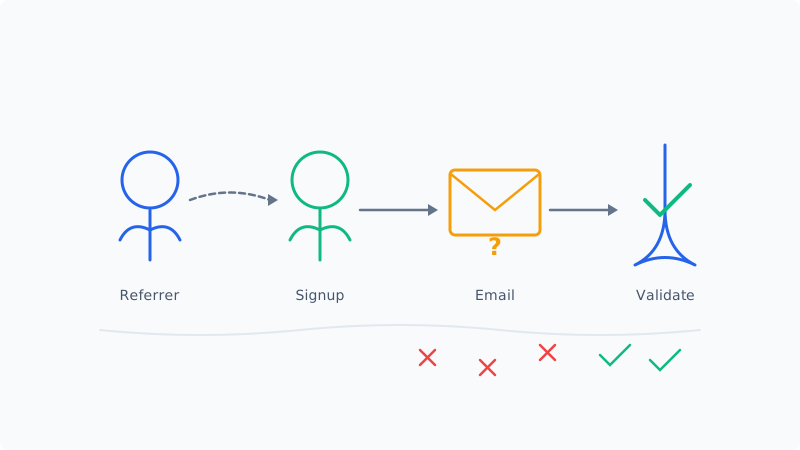
Referral programs are one of the highest-converting acquisition channels in SaaS and ecommerce. A happy customer shares a link, their friend signs up, both get rewarded. The flywheel spins, your email list grows, and marketing celebrates the cost-per-lead numbers.
But there is a problem hiding inside that growth. Referral programs incentivize quantity over quality. When you offer a reward for every signup (a discount, free month, or bonus feature), you create a system where people enter fake email addresses, misspelled addresses, or temporary disposable inboxes just to trigger the reward for the referrer.
The result is a contaminated email list that looks healthy on paper but destroys your deliverability the moment you hit send on your welcome sequence.
Why Referral Emails Are Uniquely Risky
Standard lead generation channels have built-in quality filters. Paid ads attract people with purchase intent. Content downloads require enough interest to fill out a form carefully. Webinar registrations come from people who want the information.
Referral programs bypass all of these signals. The referred person’s motivation is not your product. Their motivation is helping their friend get a reward, getting their own reward, or both. That shift in motivation creates three categories of bad email addresses.
Incentive Fraud Addresses
Some referrers game the system by entering email addresses they control (or that do not exist) to rack up rewards. They create variations of their own address, use disposable email services like Guerrilla Mail or Temp Mail, or simply type random characters followed by @gmail.com. Each fake signup triggers a reward while adding a dead address to your list.
Careless Entry Addresses
Even legitimate referrals suffer from careless entry. The referred person clicks a link, sees a signup form, and types their email quickly because the incentive (not your product) is driving the action. Typos are more common in referral signups than in any other channel because attention is lower and speed is higher.
Abandoned Inbox Addresses
Some referred users sign up with an old email address they no longer check. They want the reward but have no intention of engaging with your product. The address is technically valid (it exists, it accepts mail) but nobody reads what arrives there. These addresses become engagement black holes that drag down your sender reputation over time.
The Welcome Sequence Problem
Welcome sequences are typically your most aggressive email cadence. You send 3 to 7 emails in the first 7 to 14 days after signup. That concentrated sending pattern amplifies any list quality issues.
If 20% of your referral signups are invalid addresses and you send 5 welcome emails to each one, you generate 5 hard bounces per bad address in under two weeks. Email service providers like Gmail and Microsoft track bounce patterns at the domain level. A burst of bounces from welcome sequences signals that you are adding unverified addresses to your list, which is exactly the behavior spammers exhibit.
The penalty compounds. Your sender reputation drops. Inbox placement decreases for all subscribers, not just referral signups. Open rates fall. Click rates fall. Revenue per email falls. And the referral program that was supposed to drive growth is quietly destroying your entire email channel.
How to Build a Validation Layer Between Referral and Welcome
The fix is straightforward: validate every referral email address before it enters your welcome sequence. Here is how to implement this at each stage.
Real-Time Validation at Signup
The fastest approach is validating the email address the moment it is entered. Use an API-based validation service that checks syntax, domain existence, and mailbox status in real time. If the address fails validation, prompt the user to re-enter it before completing the referral.
This catches typos and non-existent domains immediately. The tradeoff is a slight increase in form friction, but since referral forms are already low-friction (the user is pre-motivated by the incentive), adding one validation step rarely impacts conversion rates meaningfully.
Batch Validation Before Sequence Trigger
If real-time validation is not feasible (perhaps your referral platform does not support custom form validation), run batch validation on new referral signups before triggering the welcome sequence. Instead of starting the welcome sequence immediately on signup, add a 1 to 4 hour delay and validate the batch of new addresses.
Tools like Scrubby are particularly effective here because referral signups often land on catch-all corporate domains. Standard validators see that the server accepts connections and mark the address as valid. Scrubby goes deeper, verifying whether the specific mailbox is actually deliverable. This distinction matters enormously for referral lists where people enter addresses at company domains that accept everything but deliver nothing.
Segment and Suppress Before Sending
After validation, segment your referral signups into three buckets:
- Valid, deliverable: enter the welcome sequence immediately
- Risky (catch-all, unknown): enter a reduced-frequency sequence with 2 to 3 emails instead of the full cadence
- Invalid (hard bounce, non-existent): suppress entirely. Do not send a single email.
This segmentation protects your sender reputation while still engaging the referrals that are likely real. For the risky segment, if the first email delivers without bouncing, you can graduate those addresses to the full sequence.
Measuring the Impact
Track these metrics before and after implementing validation on your referral channel:
Bounce rate on welcome sequence emails. This should drop from the 15 to 25% range down to under 2% for validated addresses.
Welcome sequence completion rate. More subscribers reaching email 5 or 7 means more activation and more revenue per referral.
Sender reputation score. Monitor your domain reputation in Google Postmaster Tools. You should see the “Bad” or “Low” reputation indicator stabilize or improve within 2 to 4 weeks of implementing validation.
Referral program ROI. Once you exclude invalid signups from your reward calculations, you get an accurate picture of what each valid referral actually costs. Many teams discover their true cost-per-valid-referral is 30 to 50% higher than the nominal cost-per-signup they were reporting.
Handling the Referrer When a Referred Email Is Invalid
This is a product decision as much as a marketing decision. When validation flags a referred email as invalid, you have three options:
Option 1: Withhold the reward. Do not credit the referrer until the referred user validates their email. This is the strictest approach and reduces fraud effectively, but it can frustrate legitimate referrers whose friends simply made a typo.
Option 2: Delay the reward. Credit the referrer after the referred user opens at least one email or completes a product action. This confirms the address is real and the person is engaged without requiring explicit re-verification.
Option 3: Flag and review. Credit the reward automatically but flag referrers with high invalid rates for manual review. If a single referrer generates 10 signups and 7 are invalid, that pattern suggests intentional gaming.
Most teams find Option 2 strikes the right balance. It protects against fraud without adding friction to the happy path.
Integration With Your Existing Stack
If you are running referral programs through platforms like ReferralCandy, Viral Loops, or GrowSurf, you can add validation as a webhook step. When a new referral signup fires, the webhook sends the email address to your validation API before the address enters your ESP.
For teams using Kali for outreach to referral leads, validating addresses before adding them to calendar invite sequences is equally important. An invalid address in a calendar invite campaign does not bounce in the traditional sense, but it generates delivery failures that calendar providers track.
The key architectural principle is: no email address from a referral program should touch any sending system (ESP, outreach tool, calendar platform) until it has been validated. Treat referral addresses with the same skepticism you would treat a purchased list, because the incentive dynamics create similar quality issues.
What About Double Opt-In?
Double opt-in (requiring the user to click a confirmation link in their email) is sometimes suggested as a solution for referral list quality. It does work as a filter, but it introduces two problems for referral programs specifically.
First, double opt-in reduces referral conversion rates by 30 to 50%. The referred user is already weakly motivated. Adding another step (check email, find confirmation, click link) loses a large percentage of them.
Second, the confirmation email itself contributes to your bounce rate if the address is invalid. You are still sending to an unvalidated address. You are just sending one email instead of five.
Validation before sending (including before the confirmation email) is the cleaner solution. You never send anything to an address you have not verified first.
Conclusion
Referral programs grow your list fast. Validation ensures that growth is real. Without a validation layer, every referral campaign is a bet that the addresses your users submit are legitimate. Given the incentive structure of referral programs, that bet fails 15 to 30% of the time.
Add validation between signup and send. Segment by deliverability confidence. Suppress the invalid addresses completely. Your welcome sequences will perform better, your sender reputation will stay healthy, and your referral program ROI will finally reflect reality instead of vanity metrics.

Scrubby Team
Admin