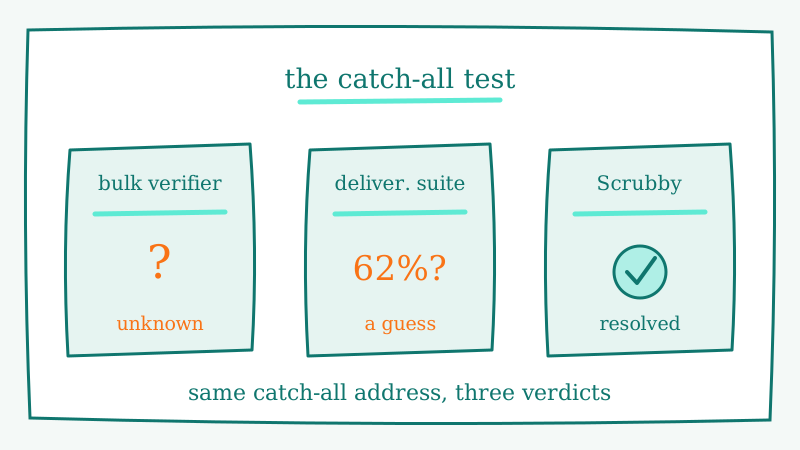
Most email verification tools agree on the easy addresses. Feed them a clearly dead mailbox and they all return “invalid.” Feed them a healthy Gmail account and they all return “valid.” The differences that actually cost you money show up in the murky middle: catch-all domains, accept-all servers, and the risky addresses that generic checkers quietly wave through or dump into an “unknown” bucket.
MillionVerifier, ZeroBounce, and Scrubby are three of the tools people compare when they get serious about list hygiene. They overlap on the basics, but they were built around different priorities. This guide walks through how each one works, where they agree, and the specific gap that separates a genuinely clean list from one that only looks clean.
The Three Tools at a Glance
Before the head-to-head, here is the short version of what each product is optimized for.
- MillionVerifier is a high-volume, low-cost bulk verifier. Its pitch is speed and price: run a large list through it quickly, get a straightforward valid/invalid/unknown split, and pay a modest per-verification rate. It is popular with cold email senders who process big lists and want a cheap first pass.
- ZeroBounce is a broad deliverability suite. Beyond core verification it bundles activity data, an abuse and spam-trap database, email scoring, and integrations. It is a mature platform aimed at marketing teams that want verification plus a dashboard of related signals.
- Scrubby is purpose-built for the addresses the other two struggle with. Instead of marking catch-all and risky mailboxes as “unknown,” Scrubby works to resolve them into a real answer, so you keep the reachable contacts other tools tell you to delete.
Where All Three Agree
On standard mailboxes, the three tools produce broadly similar results. Any credible verifier can confirm that a domain resolves, that it has valid MX records, and that a normal mailbox on a normal provider will accept mail. They also all catch the obvious problems:
- Syntax errors and typo domains like
gmial.com - Domains with no mail servers configured
- Clearly dead or deactivated mailboxes that reject on contact
- Common disposable and throwaway domains
If your list is mostly ordinary consumer and business addresses on standard providers, all three will get you most of the way there. The decision only starts to matter when a meaningful slice of your list sits on catch-all domains, which for B2B lists is often a very large slice.
The Catch-All Problem That Splits Them Apart
A catch-all (or accept-all) domain is configured to accept every message addressed to it, whether or not the specific mailbox exists, and then sort or discard it internally. To a verifier probing the server, a catch-all domain never says “no.” That creates a genuine dilemma: is sales@company.com a real, monitored inbox, or an address that will be silently dropped?
Here is how the three tools typically respond to that dilemma.
MillionVerifier flags catch-all addresses in a separate “catch-all” or “unknown” category. It is honest about the uncertainty, but it hands the decision back to you. You are left choosing between mailing addresses that might bounce or suppressing contacts that might be perfectly reachable. On a B2B list where catch-all can cover a big share of your best-fit accounts, that “unknown” pile is exactly where your revenue is hiding.
ZeroBounce also identifies catch-all domains and reports them as such, layering in its own scoring and activity data to help you guess. That extra context is useful, but a score is still a probability, not a verified answer. You are making a judgment call on each contact rather than getting a definitive verdict.
Scrubby takes the opposite approach. Rather than parking catch-all and risky addresses in an “unknown” column, it runs additional verification specifically designed to determine whether the individual mailbox is actually reachable. The result is that many addresses the other two tools give up on come back as a clear valid or invalid. If you want the full picture of why generic checkers stall here, we break it down in why catch-all email validation is the missing piece in tools like ZeroBounce or NeverBounce.
A Practical Comparison
| What you care about | MillionVerifier | ZeroBounce | Scrubby |
|---|---|---|---|
| Standard mailbox verification | Strong | Strong | Strong |
| Bulk speed and low unit price | Excellent | Good | Good |
| Extra deliverability data and scoring | Basic | Extensive | Focused |
| Catch-all / accept-all resolution | Flags as unknown | Scores, still uncertain | Resolves to valid/invalid |
| Best role in your stack | Cheap first pass | All-in-one dashboard | Rescue the “unknown” pile |
The table makes the pattern clear. MillionVerifier wins on price for a first sweep. ZeroBounce wins on breadth if you want one dashboard for many signals. Scrubby wins on the specific, expensive problem of turning ambiguous addresses into decisions you can act on.
They Are Not Mutually Exclusive
The most cost-effective setup for many teams is not “pick one,” it is layering. Run your full list through a cheap bulk verifier to strip out the obvious dead weight, then send the leftover catch-all and unknown addresses through Scrubby to recover the reachable contacts. That way you pay bulk prices for the easy verdicts and reserve deeper verification for the addresses where a wrong call actually hurts you.
This is why Scrubby is built to slot alongside other tools rather than replace them outright. If you already run ZeroBounce or MillionVerifier, the workflow is simple: export everything they marked catch-all or unknown, run that segment through Scrubby, and re-import the resolved results. You are not throwing away your existing spend, you are closing the gap it leaves behind.
How to Decide
Ask yourself where your list actually breaks.
- If your list is mostly standard consumer addresses and you just need a fast, cheap clean, a bulk verifier alone may be enough.
- If you want verification plus a wider deliverability dashboard, a broad suite fits that need, with the caveat that catch-all still comes back as a probability rather than an answer.
- If a large share of your list is B2B, catch-all heavy, or you keep seeing a big “unknown” bucket, the tool that resolves those addresses is the one that changes your results. That is precisely the job Scrubby was designed for, and you can read how teams put it to work in how to verify catch-all emails at scale and unlock 42% more leads.
The Bottom Line
MillionVerifier and ZeroBounce are both capable tools, and on the easy majority of any list they perform well. But the addresses that decide your bounce rate and your reachable-lead count are the catch-all and risky ones, and that is exactly where a valid/invalid/unknown split leaves money on the table. Instead of deleting every uncertain contact or gambling on a score, run your riskiest addresses through Scrubby and turn the “unknown” pile into contacts you can confidently keep.

Amit S.
Marketing Lead