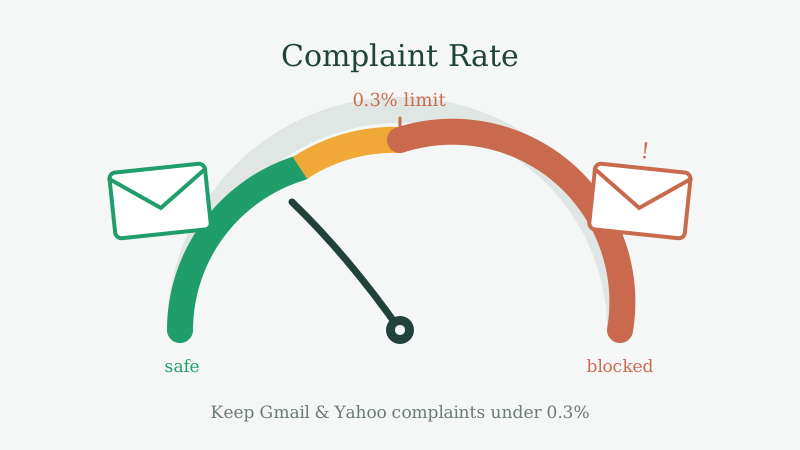
Of all the numbers that decide whether your email reaches the inbox, the spam complaint rate is the one senders understand the least and fear the most. It is a single percentage, it moves slowly until it does not, and when it crosses a line the major mailbox providers stop trusting you almost immediately. Since Gmail and Yahoo formalized their sender requirements, that line has a hard number attached to it, and staying under it is no longer optional.
This guide breaks down what the complaint rate actually measures, why it rises even for senders who think they are doing everything right, and the concrete steps that keep it safely in the green.
What the spam complaint rate really measures
Your spam complaint rate is the share of delivered emails that recipients mark as spam. If you deliver 100,000 messages and 250 people hit the “report spam” button, your complaint rate for that send is 0.25 percent.
The important word is delivered. Complaint rate is calculated against messages that actually landed in an inbox, not against your full send list. That distinction matters, because it means a small number of annoyed recipients can produce an alarming percentage when your delivered volume is modest.
Two things make this metric uniquely dangerous. First, it is a direct human signal. A bounce is a technical event, but a complaint is a person telling the mailbox provider “I did not want this.” Providers weigh that far more heavily than almost any other signal. Second, you often cannot see the complaints directly. Unless you have set up a feedback loop, the “report spam” click happens inside the recipient’s inbox and never touches your system. You feel the consequence, worse inbox placement, without ever seeing the cause.
The number you cannot cross
In their sender guidelines, both Gmail and Yahoo drew an explicit line:
- Keep your spam complaint rate below 0.3 percent. This is the ceiling. Cross it consistently and you should expect throttling, spam foldering, or outright blocking.
- Stay under 0.1 percent as your real target. Google is clear that 0.3 percent is the point where things break, not a goal to aim for. Healthy senders sit at or below 0.1 percent, which is one complaint per thousand delivered messages.
To put that in perspective, at a 0.1 percent working target you have room for exactly one complaint per 1,000 delivered emails. At the 0.3 percent ceiling, three complaints per 1,000 is enough to put you in the danger zone. These are tiny margins, which is why complaint rate has to be managed proactively rather than fixed after the fact.
It is also worth knowing that providers look at the rate over a rolling window, not a single campaign. One bad send will not necessarily sink you, but a pattern of elevated complaints will. That is both a warning and a relief: you have time to correct course, but you cannot ignore a creeping trend and hope it resolves itself.
Why complaint rates climb
Complaints almost never come from a single cause. They accumulate from several habits that each seem harmless in isolation.
Recipients do not remember opting in
The most common driver of complaints is simple: the person genuinely does not recognize you. Maybe they signed up eight months ago, maybe the consent was buried in a checkout flow, maybe you acquired the list from a partner. When an unfamiliar sender shows up, “report spam” is faster than hunting for an unsubscribe link.
Unsubscribing is hard, so complaining is easier
When people cannot find an obvious way out, they take the exit that is always one click away. If your unsubscribe link is small, slow, or asks them to log in, you are actively training recipients to complain instead. This is exactly why Gmail and Yahoo now require a working one-click unsubscribe header on bulk mail.
Sending to people who never engage
A recipient who has ignored you for a year is far more likely to complain than one who opens regularly. As you keep mailing disengaged contacts, you are drawing complaints from your least interested audience while diluting the engagement signals that protect you.
Frequency and relevance mismatches
Emailing too often, or sending content that does not match what someone signed up for, both spike complaints. A subscriber who wanted your monthly newsletter and now gets four promotional blasts a week feels ambushed, and the spam button is how they say so.
Bad and risky addresses inflating the denominator problem
Here is the subtle one. When your list is full of invalid or risky addresses, your deliverable volume shrinks, so the same raw number of complaints represents a larger percentage. Worse, sending to unengaged and undeliverable addresses damages your reputation on its own, pushing more of your legitimate mail toward the spam folder where it is more likely to be reported. Cleaning your list with a validation tool like Scrubby removes the dead weight that quietly makes your complaint rate look worse than your content deserves.
The playbook for keeping complaints low
Reducing complaint rate is not one lever. It is a set of habits that compound. Here is the practical order to work through them.
1. Only mail people who clearly asked for it
Every durable fix starts with consent. Use clear opt-in language at signup, and for high-value programs consider double opt-in so there is no ambiguity about who agreed. Never mail a purchased or scraped list. Purchased lists are complaint factories because none of those recipients know you, and a wave of complaints from strangers is the fastest way to torch a sending domain.
2. Make unsubscribing effortless
Put a visible unsubscribe link in every email and implement the list-unsubscribe header so Gmail and Yahoo can show a native one-click option. Counterintuitive as it feels, making it trivially easy to leave lowers your complaint rate, because people who are done choose the clean exit instead of the spam button. An unsubscribe costs you one contact. A complaint costs you reputation with everyone.
3. Validate your list and keep it clean
Send to addresses that are real and reachable. Validate new addresses at the point of capture so typos and fake entries never enter your database, and run periodic cleaning passes on your existing list to strip out addresses that have gone bad. Standard validators struggle with catch-all and risky domains, which is the exact gap Scrubby is built to close, so you can verify the addresses other tools simply guess on. A clean list means you are mailing real people who chose you, which is the foundation every other tactic sits on.
4. Suppress the disengaged before they complain
Build a re-engagement segment for contacts who have not opened in 90 to 180 days. Send a focused win-back sequence, and if they still do not respond, suppress them. It feels like losing subscribers, but you are removing precisely the people most likely to report you. If your outreach spans more than email, coordinating a lighter-touch follow-up through a channel like Kali can re-open a conversation without hammering an inbox that has already tuned you out.
5. Match frequency and content to expectations
Send at a cadence people signed up for, and keep the content aligned with what they were promised. Segment your list so recipients get relevant mail rather than everything you produce. Relevance is the single biggest reason people keep an email instead of reporting it.
6. Watch the number and set up feedback loops
Register for feedback loops with the major providers and monitor complaint rate per campaign, not just as a lifetime average. Watching the trend lets you catch a bad segment or a mistimed send before it becomes a pattern that providers punish. If a particular list or content type spikes complaints, you want to know within a day, not a quarter.
What to do if you are already over the line
If your complaint rate is already brushing against 0.3 percent, treat it as an emergency and pull back hard. Stop mailing your least engaged segments immediately, since they are the ones generating complaints. Run a full validation and cleaning pass to cut invalid and risky addresses. Audit your unsubscribe flow and make sure the one-click header works. Then rebuild volume gradually, mailing only your most engaged contacts first and expanding outward as your metrics recover. Reputation heals slowly, so patience and a smaller, cleaner list will get you back faster than trying to power through.
The bottom line
Your spam complaint rate is the clearest verdict your recipients can deliver on whether they want your email. Gmail and Yahoo made that verdict enforceable by putting a hard number on it, 0.3 percent as the ceiling and 0.1 percent as the real target. Staying under it is not about clever tricks. It is about mailing people who asked to hear from you, making it easy to leave, keeping your list clean and validated, and letting go of the contacts who have already checked out. Do those things consistently and the complaint rate takes care of itself.
If you are not sure how much of your current list is quietly working against you, start by running a validation pass with Scrubby and see how many risky and dead addresses are inflating your risk before your next send.

Nick Abraham
Cold Email Expert