You built your email list carefully. You collected addresses at signup, confirmed them, and watched the numbers climb. Then, month after month, something quietly went wrong. Open rates slipped. Bounces crept up. A campaign that used to land in the primary inbox started showing up in spam. Nothing dramatic happened on any single day, but the list you trusted stopped performing.
That slow rot has a name. It is called email list decay, and it happens to every list, including well maintained ones. Understanding why it happens, and building a routine to counter it, is the difference between a list that compounds in value and one that slowly poisons your sender reputation.
What email list decay actually is
Email list decay is the gradual process by which valid, engaged contacts on your list become invalid, unreachable, or disengaged over time. It is not a single event. It is the natural entropy of human behavior colliding with your database.
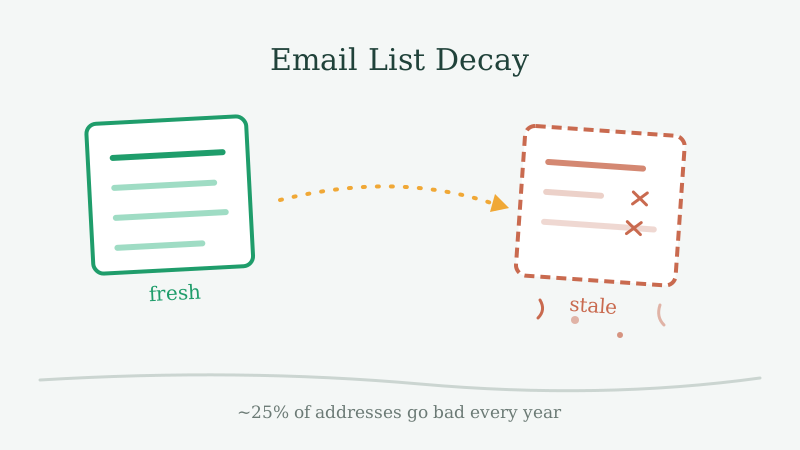
Industry research has long put the annual decay rate at roughly 20 to 30 percent. That means if you collected 10,000 addresses today and never added a single new one, you could reasonably expect 2,000 to 3,000 of them to be dead or useless within twelve months. Left unchecked, half your list can go stale in about two years.
The tricky part is that decay is invisible from the inside. A dead address does not tell you it died. It simply sits in your database looking exactly like a good one until you send to it and get punished for it.
The forces that make lists go stale
List decay comes from several directions at once. It helps to separate them, because each one calls for a different fix.
People change jobs
This is the single biggest driver of B2B decay. When someone leaves a company, their work address is usually deactivated within weeks. The average professional now changes roles every few years, so a corporate list sheds contacts constantly. The address jsmith@acmecorp.com does not bounce because the person is unreachable in life. It bounces because that mailbox no longer exists.
Inbox abandonment
On the consumer side, people accumulate email addresses and quietly stop checking them. A student graduates and abandons a university address. Someone creates a throwaway inbox to grab a discount code and never opens it again. These addresses may still technically exist, but nobody is home, and mailbox providers notice when you keep sending to accounts that never engage.
Provider and domain changes
Companies get acquired and migrate domains. Small businesses let a domain lapse. Consumers switch from an old provider to a new one. Each of these events silently breaks a chunk of your list without any action on the subscriber’s part.
Typos and bad data at capture
Not all decay happens after signup. Some addresses were broken the moment they entered your database. A misspelled domain, a fat-fingered character, or a fake address dropped into a form all count as decay that started on day one. Catching these at the point of entry is far cheaper than cleaning them up later, which is why validating addresses at signup with a service like Scrubby stops a large share of decay before it ever reaches your sending list.
Disengagement
The subtlest form of decay is not a broken address at all. It is a real person at a real inbox who has simply stopped caring about your email. Disengaged subscribers drag down your engagement metrics, and modern mailbox providers weigh engagement heavily when deciding where to place your mail. A list full of people who never open is a deliverability problem even when every address is technically valid.
Why decay is more dangerous than it looks
A stale list is not just a smaller list. It actively works against you in ways that compound.
When you send to decayed addresses, your bounce rate rises. Mailbox providers read a high bounce rate as a signal that you are not maintaining your list, and they respond by routing more of your mail to spam. Some of those dead addresses have been recycled into spam traps, and hitting a trap can get you blocklisted outright. Meanwhile, the disengaged contacts who never open pull your open and click rates down, which further erodes the reputation signals that determine inbox placement.
The result is a vicious cycle. Decay hurts deliverability, worse deliverability means even your good contacts stop seeing your mail, and lower engagement accelerates the appearance of decay. A list you never clean does not stay flat in value. It declines.
If you want a deeper look at how bounces specifically damage sender standing, our guide on soft bounce versus hard bounce breaks down what each bounce type is telling you about the address behind it.
How to measure your decay rate
You cannot manage what you do not measure. Before you fix decay, quantify it so you know how aggressive your maintenance needs to be.
Track these numbers over time:
- Hard bounce rate per send. A steady climb here is the clearest signal of accumulating dead addresses. Anything consistently above 2 percent needs attention.
- Unknown user bounces specifically. These are addresses that no longer exist, the purest form of decay, as opposed to temporary soft bounces.
- Open and click trends by cohort. Group subscribers by the month they joined and watch how engagement fades. This tells you how quickly your particular audience goes cold.
- Percentage inactive. Count contacts who have not opened or clicked in 90, 180, and 365 days. This is your disengagement reservoir.
Run a validation pass on a sample of your list and you will often be surprised how many addresses are already dead. That number is your baseline decay, and it tells you how overdue a cleaning is.
The routine that keeps a list healthy
Fighting decay is not a one time project. It is a rhythm. Here is a practical maintenance cadence that works for most senders.
Validate at the point of entry
The cheapest decay to fix is the decay you never let in. Put real time validation on every signup form, checkout field, and lead capture point so typos, fake addresses, and undeliverable domains are caught before they reach your database. This alone can dramatically slow the rate at which your list rots.
Clean the full list on a schedule
Even with entry validation, addresses go bad after they join because people change jobs and abandon inboxes. Run a full validation pass on your entire list on a regular schedule, quarterly for most senders and monthly for high volume programs. A validation tool that can accurately verify catch-all and risky addresses, not just obvious dead ones, will catch far more decay. This is exactly the gap Scrubby was built to close, because standard validators tend to guess on catch-all domains and leave decayed addresses hiding in your list.
Segment and manage the disengaged
Not all decay is a dead address. For real people who have gone quiet, build a re-engagement segment and send a focused win back sequence before you give up on them. If they still do not respond, suppress them. Keeping unresponsive contacts on your active list to protect a vanity metric is a false economy that costs you deliverability. If your outreach mixes email with other channels, coordinating that follow up through a tool like Kali helps you reach people who have stopped opening email without simply blasting a dead address again.
Confirm intent for high value programs
For your most important sends, double opt in and periodic re-permission campaigns keep your list anchored to people who genuinely want to hear from you. A smaller list of confirmed, engaged subscribers outperforms a bloated list riddled with decay every single time.
The mindset shift that matters most
The teams that beat list decay stop treating their email list as an asset that only grows. They treat it as a living thing that needs constant tending. Growth and cleaning are two halves of the same job. Adding new contacts without removing decayed ones is like pouring water into a leaking bucket and celebrating the rising level while the floor gets wet.
Decay is not a sign you did something wrong. It is the default state of every email list on earth. What separates high performing senders is not that their lists never decay. It is that they measure the decay, validate aggressively at entry, clean on a schedule, and let go of contacts who are gone. Do that consistently, and your list becomes something rare: a database that gets more valuable over time instead of quietly turning against you.
Start by finding out how much of your current list is already dead. Run a validation pass with Scrubby, look at the number, and let it tell you how overdue your next cleaning really is.

Amit S.
Marketing Lead