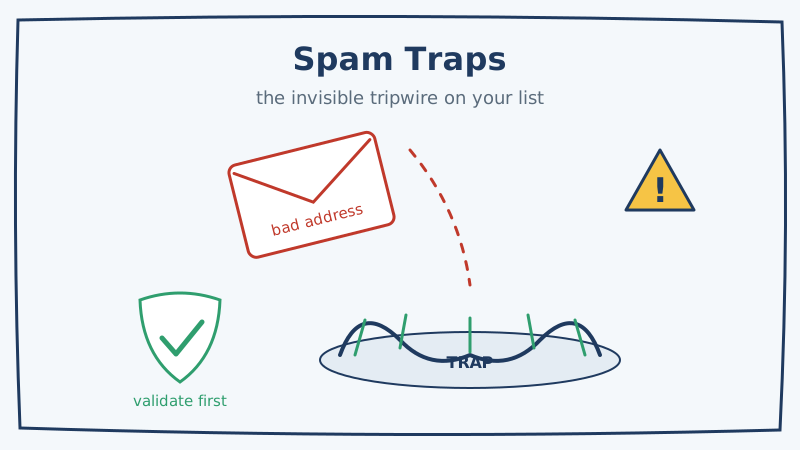
You can do everything else right, authenticate your domain, warm up your IP, write a tight subject line, and still land in the spam folder because of a handful of addresses you never should have mailed. Those addresses are spam traps, and mailbox providers and blocklist operators use them as tripwires to catch senders with sloppy list hygiene.
The frustrating part is that spam traps are invisible. They look like ordinary email addresses, they do not bounce, and no one behind them will ever reply or complain. You only find out you hit one when your inbox placement collapses or your domain shows up on a blocklist. This guide breaks down what spam traps actually are, the different types you can run into, how they sneak onto a list, and the practical steps that keep them out.
What a Spam Trap Actually Is
A spam trap is an email address that exists for one purpose: to catch senders who are not managing their lists properly. The address is never used to sign up for anything legitimate, so any mail that reaches it is, by definition, mail the sender should not have sent. Mailbox providers, anti-spam organizations, and blocklist operators plant these addresses and watch who mails them.
When you hit a trap, the operator draws a simple conclusion. You either bought or scraped your list, you never validated it, or you are mailing contacts who went cold years ago. None of those are good signals, and the penalty ranges from a quiet reputation ding to a full blocklist entry that blocks delivery across thousands of receiving domains at once.
The reason traps are so effective is that they cost you before you can react. There is no bounce to warn you and no unsubscribe to log. The damage happens silently, and by the time you notice the symptoms, the trap has already fed weeks of negative data to the systems that decide where your mail lands.
The Main Types of Spam Traps
Not all traps are the same, and understanding the differences tells you a lot about how one ended up on your list in the first place.
Pristine traps
Pristine traps are addresses that were created solely to be traps. They have never belonged to a real person and have never opted in to anything. Anti-spam groups and blocklist operators seed them across the web, in places where only a scraper would find them. If a pristine trap is on your list, it almost always means the address was harvested or the list was purchased. Pristine traps carry the harshest penalties because hitting one is strong evidence of scraping.
Recycled traps
Recycled traps are more common and, in some ways, more dangerous because they can catch even honest senders. A recycled trap is an email address that once belonged to a real person but was abandoned. After a long period of inactivity, the mailbox provider deactivates it, lets it hard bounce for several months, and then reactivates it as a trap. Any sender still mailing that address is clearly not paying attention to engagement or bounce data. Recycled traps are why mailing a list you have not cleaned in a year is so risky.
Typo and malformed traps
Some operators register domains that are common misspellings of major providers, such as a domain that looks almost like gmail or yahoo but has one letter off. When a user fat-fingers their address on a signup form, the message goes to the typo domain, which the operator uses as a trap. These are less about buying lists and more about weak signup validation, and they are entirely preventable at the point of collection.
How Spam Traps End Up on Your List
Traps do not appear at random. Every one of them traces back to a specific gap in how a list is built or maintained.
The biggest source is purchased or rented lists. If you did not collect an address through your own opt-in, you have no idea where it came from, and bought lists are riddled with both pristine and recycled traps. This is the single fastest way to poison a sending domain, and it is why reputable senders never buy lists.
Scraping is the next culprit. Pulling addresses off websites, directories, or social profiles sweeps up the exact pristine traps that operators plant in those locations. The traps are bait, and scrapers are the intended catch.
The subtler sources are the ones that trip up well-meaning senders. Old, unengaged contacts eventually decay into recycled traps. A contact who has not opened an email in two years may already be sitting on a deactivated mailbox that is one reactivation away from becoming a trap. Weak signup forms let typo traps and fake entries through, especially if you allow addresses onto your list without any verification step. And letting anyone submit an address without a confirmation email means bots and pranksters can plant bad addresses for you.
Why One Trap Can Do So Much Damage
It is tempting to think a single bad address in a list of fifty thousand cannot matter much. In practice, it can. Blocklist operators and mailbox providers are not measuring the percentage of your list that is traps in isolation; they are treating a trap hit as a proxy for how you built the whole list. One pristine trap says scraping. A cluster of recycled traps says stale data and no engagement filtering.
The consequences compound. A blocklist entry can suppress delivery to every domain that subscribes to that blocklist, which for a major operator means a huge share of the inboxes you care about. Even without a formal listing, trap hits drag down the reputation score that providers like Gmail and Outlook attach to your domain, and a lower score means more of your legitimate mail slides into spam. Recovering from that takes weeks of careful sending, so prevention is far cheaper than the cure.
How to Keep Spam Traps Off Your List
The good news is that spam traps are preventable. Every defense comes down to controlling what gets onto your list and continuously pruning what has gone stale.
Never buy, rent, or scrape lists. This eliminates the most trap-dense sources in one move. Grow your list through your own opt-in channels so you know the origin of every address.
Use confirmed opt-in for new subscribers. Sending a confirmation link before adding someone ensures a real person controls the mailbox and filters out typo domains, bots, and fake entries at the door.
Validate addresses before you send. This is where verification does the heavy lifting. A validation pass catches malformed addresses, disposable domains, and addresses that no longer accept mail before they ever reach a campaign. Running your list through Scrubby lets you screen out the risky and undeliverable addresses that would otherwise sit on your list and decay into recycled traps. Scrubby is built to resolve the hard cases that ordinary verifiers skip over, including catch-all and accept-all addresses that hide their true status.
Prune unengaged contacts on a schedule. Recycled traps come from stale data, so a contact who has not opened or clicked in twelve to eighteen months should be moved to a re-engagement track and then suppressed if they stay silent. Do not keep mailing addresses that have gone quiet for years.
Watch your bounce and engagement metrics. A rising hard bounce rate or a segment of the list that never engages is an early warning that traps or dead addresses are accumulating. Clean proactively rather than waiting for a blocklist notice.
What to Do If You Think You Already Hit One
If your inbox placement has dropped or you have landed on a blocklist, the first move is to stop mailing the segments most likely to contain traps, usually your oldest and least engaged contacts. Then validate the entire list so you can remove undeliverable and risky addresses before you send anything else. A clean, verified list is also what most blocklist operators want to see before they will consider a delisting request.
From there, tighten the front door. Turn on confirmed opt-in, add validation to every signup path, and set a recurring cadence for cleaning. Ongoing hygiene with a tool like Scrubby is what keeps recycled traps from re-forming on your list over time, because the addresses that would become traps get caught and removed while they are still just risky, not yet poisonous.
The Bottom Line
Spam traps are the clearest signal a mailbox provider has that a sender is not managing their list, and they punish that signal hard. You cannot see traps directly, so you fight them indirectly: never acquire addresses you cannot vouch for, confirm every new subscriber, validate before you send, and retire contacts who have gone cold. Do those four things consistently and traps have nowhere to take root. The senders who stay out of the spam folder are not the ones who react fastest to a blocklist; they are the ones who never gave a trap a way onto the list in the first place.

Amit S.
Marketing Lead